

Ever wondered what goes into making a rhythm game that breaks the mold? We sat down with the developer of Beat Heart Beat, the upcoming absurd rhythm-platformer that challenges you to slash your way towards your withered Heart. This game immediately stands out with its bold, collage-like visuals and a distinct alt-rock soundtrack, steering clear of the genre’s usual electronic dominance. In this interview, the developer dives into the surprising inspirations behind the game—from the frenetic action of Katana Zero and the flow of Rayman Legends to the unique aesthetics of shows like Madoka Magica —and reveals how they tackled the challenges of merging rhythm with physics-based action. They also share the development journey, the crucial impact of playtesting, and the exciting roadmap leading up to the Early Access release in early 2026.
Describe Beat Heart Beat in one sentence for someone who’s never heard of it.
Beat, Heart, Beat is an absurd rhythm-platformer about tearing a path towards your withered Heart.
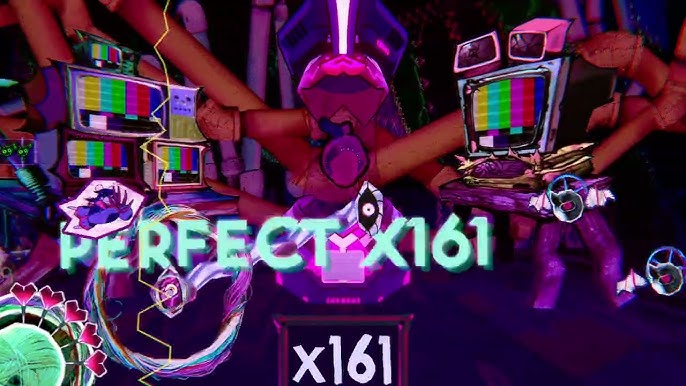
One of the first things I noticed about Beat Heart Beat is its striking visuals—the mix of 3D and 2D elements, the expressive character designs, and the collage-like aesthetics are all incredibly bold. It vaguely reminds me of the work of Yugo Limbo. What were some of your inspirations for the art direction?
I’m incredibly humbled by the Yugo Limbo comparison; I’m certain they’ve subconsciously affected my direction—especially their character design! I’ve always been drawn to mixed media for its capability to highlight uncanniness and dissonance as something beautiful and appealing in its own right. The work of Sodikken, Joel Guerra, and Felix Colgrave comes to mind as the biggest inspirations, as well as Madoka Magica‘s witch scenes, Coraline, and the HBO show Crashbox.
On a related note, what does the workflow or production pipeline look like for art creation in Beat Heart Beat?
As for the pipeline, I’ll be fully transparent and say that I am NOT an artist in any formal capacity, so production usually consists of a cycle of concept, iterate, rough asset, iterate, until we have something that we all like. My art direction could be described as “vibes-based,” or in other words, “a disaster”, so I’m very thankful my artists Benji, Annalivia, Annie, and both Andrew(s) can transform the junk in my brain into what you see on the screen.
Musical Inspirations & Production
Another standout element of Beat Heart Beat is its soundtrack. The rhythm game genre is often dominated by electronic music, but The Wacy took a distinct alt-rock approach. What inspired this musical direction? And building on that, how is the music in Beat Heart Beat produced? Is it commissioned, licensed, or created in-house?
It’s a little embarrassing but fun background, but during quarantine and being pretty miserable for several reasons, I found myself listening to a lot of super sappy alt-rock, grunge, and Midwest emo. Those genres continued to stick with me long after, and arguably led to the creation of Beat, Heart, Beat. In general, I also felt as though there were so many underrepresented genres in rhythm games, and I wanted to showcase something new. As for references, Glass Beach, Bedroom, Surf Curse, and Car Seat Headrest come to mind.
As far as sound production, our lead composer Sophie quite literally does it all—SFX, in-house composition, and pulling from her own personal albums. A lot of our guest artists were gracious enough to permit us to use their tracks, and a few friends have composed specifically for us.
Haha, that’s awesome! I am a huge Surf Curse fan, saw them in Reno a few years back, was a great concert! I got to say, I’m really looking forward to the soundtrack. When I first heard the main trailer, I was immediately hooked, and the song in it, “Did it Hurt When You Fell From Heaven?” was in my playlist for a while after!
When settling on the game’s visual and audio aesthetic, were there any alternate styles or directions you experimented with but ultimately moved away from?
Finding a balance between a maximalist, multimedia visual style and a legible gameplay scene is very tough and has required lots of iteration. We’ve leaned very hard into collage at times, and very hard into line art in earlier drafts. You could even say we’re still trying to strike a balance! Luckily, the style and tone of BHB were nailed down quite early, so it was less about what it would look like and more about how far we could push each aesthetic.
As I mentioned before, the audio aesthetic predates the game itself in many ways, so the direction was pretty clear to us from the start. I’d say the biggest change is actually that, over time, I opened myself up to other genres being in the game. I originally wanted an entirely grunge soundtrack, but we have some bonus tracks like Sivee’s “Loser Girl” and Allen Cai’s “See the Sun” that explore different genres like electronic and pop!

Core Mechanics & Design
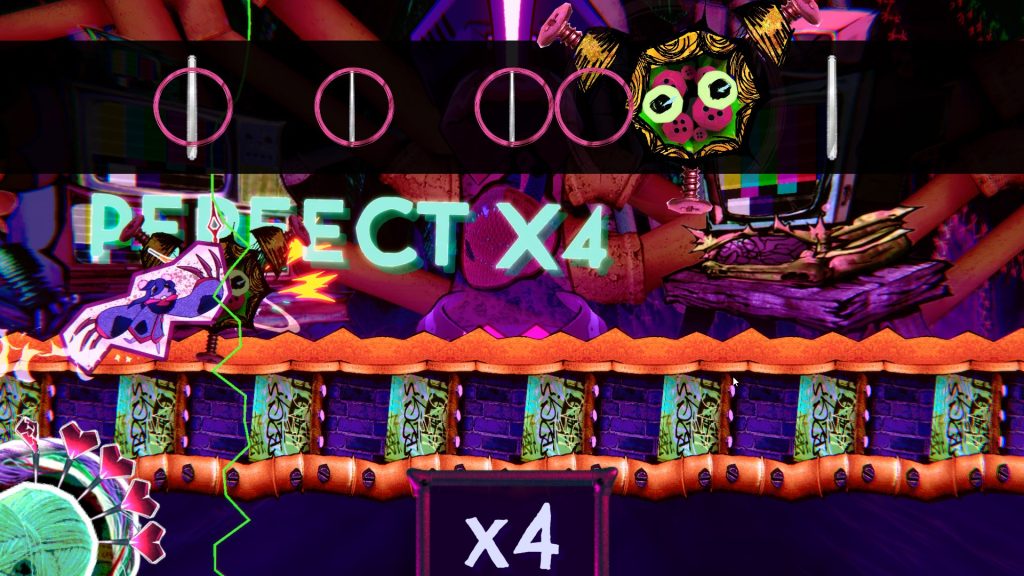
The demo lets players chain attacks together, soaring through enemies and building momentum to the beat. How did you land on that as the game’s core mechanic?
It’s actually a pretty wild story. The first doc written for BHB dates back to February 2021, two years before it actually began development! At the time, the game was a pure platformer where, every beat of the song, a Heart would drop obstacles onto you, and you’d try to chase it. I shelved the idea as I finished up college, but I distinctly remember flying home for the holidays one time, listening to a pre-downloaded Spotify playlist, and reimagining a little guy platforming through a level and just slashing through enemies with crazy air combos to the music. I could see it vividly enough to the point where I wrote a preliminary doc on my notes app that I would then propose to my co-lead after graduation. The mechanics themselves were deeply inspired by Rayman Legends’ music levels, the combat of Muse Dash and UNBEATABLE, and the call-and-response mechanics in Rhythm Heaven.
I noticed that Rayman Legends’ influence when I played the demo. There is a sense of speed, responsiveness, and enemy placements that’s very reminiscent of it. How do you design enemy encounters, level layouts, and movement systems to keep that sense of rhythm and flow alive rather than breaking it?
Through blood, sweat, and playtesting. I mean, in all honesty, it’s largely thanks to my co-lead, Andrew, for developing a preliminary version of the in-game level editor within the first month of development. Which is nuts to do, by the way. Most of my ideas wouldn’t have come to life without his help, so I’m especially lucky for his contributions.
After that, I remember taking whatever songs I was listening to at the time, dropping them into the game, and charting tons of “fan levels,” I guess you could call them. I was a bit indulgent in how many I made, but it let me test the high-end potential of difficulty, discover my own charting principles, and let me tweak a lot of physics values to make it feel right. For charting specifically, I’ve found that pattern repetition and variations are your best friend, and a lot of the time it’s more important to find the “feeling” of the chart than making it as objectively accurate as possible. I will also note: a lot of my early charts were HOT garbage. I don’t have a charting background, so most of it was lots of practice and playtesting from family members and friends of different skill levels. Thanks, Mom!
Were there any surprising influences—musical, cinematic, or mechanical—that shaped how you approached those systems?
I think the most surprising influence that comes to mind is probably Katana Zero. I really wanted to capture that visceral feeling of seeing a group of enemies, forming a plan, and just executing something crazy. My favorite rhythm games are ones that incorporate context and character into their mechanics, where it feels like you’re actually interacting with the game world and not just clearing notes on the screen, like in Hi-Fi Rush or Patapon. While those games hybridize 3D action-platformers and RTS, respectively, I suppose the subconscious pitch of BHB was a personal take on seamlessly combining Devolver Digital-style action with rhythm.
When developing the rhythm-combat mechanics, were there any prototypes or ideas you loved conceptually but found just didn’t work in practice?
I originally really wanted the up and down slashes to be momentum-based, where instead of traveling to the note, you follow through it. This would’ve added more interesting physics gameplay, but it was unbelievably annoying for sightreading since there was so much variation in where Peccori would travel when slashing. While it wasn’t the right fit, the pogo and launcher enemies are a few spiritual successors to the idea that try to add a bit of physics-based movement. Oh, there’s also the Dasher enemy. We recently showcased the Tinktonk enemy, which is an improvement on the idea, but there is an evil, unused enemy lurking in our project files. Maybe one day I’ll throw a rogue one into a chart, who’s going to stop me?
Development, Tech, and Roadmap
For players looking ahead to the full release, what new mechanics, boss fights, or musical moments are you most excited for them to experience?
I’m very, very excited to see people react to the Story Mode. We’re planning on introducing new mechanics, enemies, characters, and a ton of weird nonsense that we think players will love. I think I’m most excited to see how people react to the party members that help Peccori along the way and how they might affect gameplay. Perhaps you’ll be able to meet them pretty soon!
How long has Beat Heart Beat been in development, and how has your vision evolved from the early prototypes to what players see today?
We started development in late 2023 and just released our second demo as of September 2025! I think the biggest change between the early game and now is the physics. Peccori used to have this REALLY awkward jump that stalled it in the air by default at a fixed height, and it wasn’t doing the platforming part of our rhythm-platformer any favors. Another major addition is slopes, where our levels used to be tile-based and completely flat. We really want to obfuscate that what you’re playing through is a “chart” and add more natural height and movement, and we have plans to push that even further in the future.
Has player feedback from demos or playtests led to any major design changes or surprising insights?
Yes! Player feedback is just about the most helpful thing out there. I think one underlooked thing that meant a lot was hearing about ways we could improve accessibility, especially since our game is visually, sonically, and technically pretty intensive at times. We just did a massive bugfix patch using the Discord bugs list as a basis, too—if you voluntarily report bugs as a player, you are my hero.
Some of my favorite player insights come from in-person tests, too. It always feels oddly affirming when people really clock my inspirations, like the Heart and Peccori’s rapport resembling the King of All Cosmos and The Prince from Katamari Damacy, or asking us if we’ve heard Glass Beach or seen Madoka Magica or something. When someone compares your work to something that you, as a creator, deeply respect, it feels especially rewarding.
From a technical standpoint, what does your development pipeline look like? What tools, engines, or plugins do you rely on most to bring your ideas to life?
We develop in Unity with GitHub for source control and FMOD, an audio middleware that allows us to sync music and do some fun dynamic music/SFX stuff. Andrew works on the backend, like the level editor, cutscene system, etc., and I do technical frontend design, like enemy implementation, creating environments and levels, and other random bits of scripting. I am the de facto producer on this project (and de facto many other things), which has been a great learning experience, but our pipeline is pretty informal and changes based on our needs for an upcoming milestone. I use Figjam, Evernote, and Milanote for my documentation and production, which I really enjoy, but I think my teammates are going to kill me if they have to create another account.
What’s the roadmap moving forward—upcoming features, release goals, or new levels and tracks you’re excited about?
I am super excited to announce that Beat, Heart, Beat will be entering Early Access in early 2026, featuring a user-level editor and the next chapter of the Story Mode. Expect new songs, backgrounds, enemies, characters, and more!!
Our penultimate question comes from the Born in Reverie developer, Axial Escape. They asked: What is your favorite part of developing your project, and what aspect do you most dread having to work on?
I think I’ll start with what I dread to not end on a bummer. I think marketing and project management can be really stressful at times, and it’s one of those things you don’t really even think about when you’re going into indie development. If I had to pick something from specifically the development process, I think I personally struggle knowing when to refactor old code or redo a level environment or something—basically anything that pokes at my perfectionism and OCD.
My favorite part of development has to be the process of crafting mechanics that recontextualize gameplay, like new enemy types or hazards. I think that’s my favorite part of design in general: once the framework is there, you can twist and push different parts of the design in ways you hadn’t originally anticipated. Outside of design, I’ve had a surprising amount of fun with creative writing for the Story Mode and designing modular systems on the programming end. There’s something satisfying about finally seeing the moving parts of a script click nicely, which is something that I could attribute to writing or programming!
What would you like to ask the next SDC Game Spotlight recipient?
Has a real-life experience or piece of non-game media influenced or inspired your work in some significant way? If so, how do you think your design philosophy, aesthetics, etc., have changed as a result?
Finally, how can players follow your progress, support the game, or get involved in the Beat Heart Beat community?
Beat, Heart, Beat has a demo on Steam that you can play and wishlist RIGHT NOW!! Sharing the game in general is so, so helpful and very much appreciated. If you want to chat about the game or give feedback, you can check out our Discord as well!
Here’s all of our links: https://linktr.ee/beatheartbeatgame
Thanks so much! Nik
From physics tweaks to story design, this conversation provided a fantastic look at the passion and iteration driving Beat Heart Beat‘s development. We learned about the happy accident that led to its core air-combo mechanic, the importance of finding the “feeling” over objective accuracy when charting levels, and the ongoing evolution of the game’s visuals. As the team finalizes the Story Mode and prepares to launch into Early Access in early 2026, players can look forward to new content, party members, and a user-level editor. If you’re excited to see this unique blend of action and rhythm come to life, be sure to check out the demo on Steam and connect with the community via their Discord to share your feedback.